Trump and Congress cut funding for Planned Parenthood. Can Botox keep it afloat?
After President Trump and Congress cut certain Medicaid funding to Planned Parenthood in last year's budget, some clinics have started offering aesthetic services, including Botox, to stay afloat.
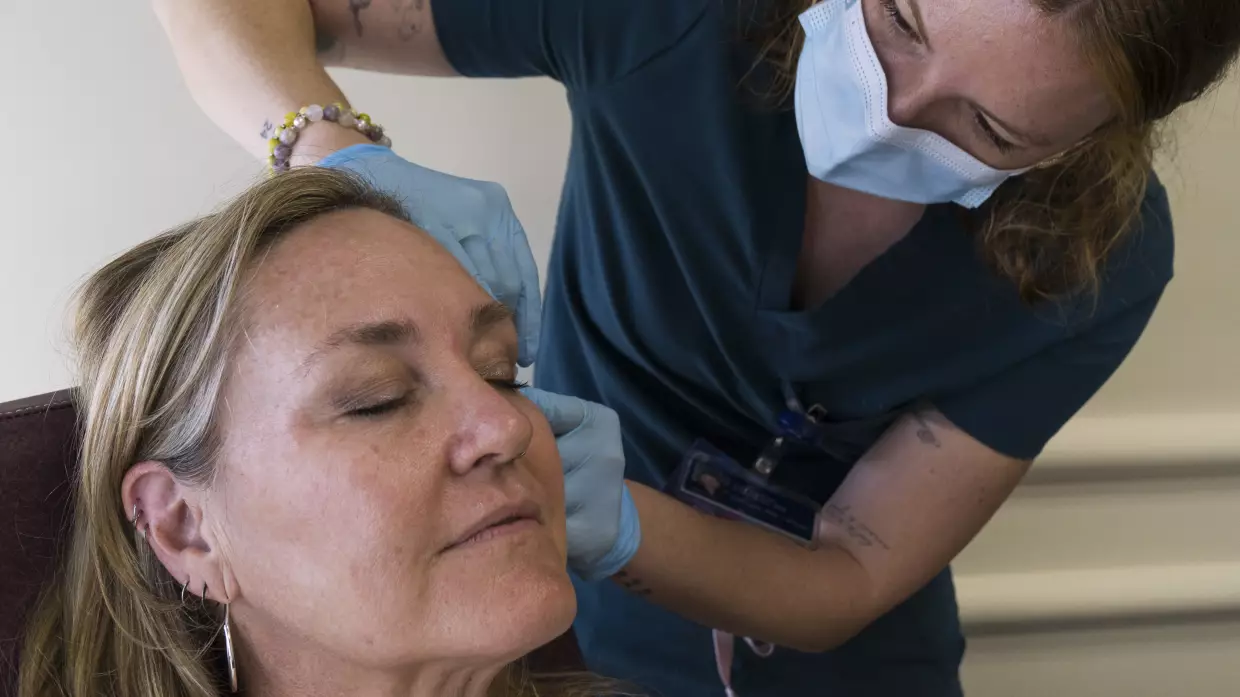
Samantha Pohlman, a registered nurse, performs a cosmetic treatment procedure on Christine Ruiz at Planned Parenthood - B Street in Sacramento, Calif., Friday, March 20. Planned Parenthood is expanding its services by offering cosmetic treatments like injections to expand its revenue sources.
SACRAMENTO, Calif. — As Christine Ruiz sits in an exam room for some aesthetic skin treatments, she looks nervous. She's not new to injectables like Botox, but this is the first time she's received them at a Planned Parenthood clinic.
"So, I usually do the elevens and then across the forehead. I really like the little lip flip," Ruiz says to her clinician, describing what she wants done.
The Sacramento clinic is part of Planned Parenthood Mar Monte, the largest Planned Parenthood affiliate in the country, covering Northern California and parts of Nevada.
It has started offering a new set of services, ranging from Botox to IV hydration for skin rejuvenation, or for after a night of drinking, all of which patients pay for with cash. They can also request sedation for certain procedures, like the placement of an intrauterine device.
The shift comes as Planned Parenthood faces financial uncertainty after President Donald Trump and Congress stripped funding for the abortion-rights organization as part of the tax and spending package passed last year. The cuts, which prevent Planned Parenthood and other organizations that perform abortions from accepting Medicaid as payment for non-abortion services, are set to expire this summer. Congress could renew them for another year.
The affiliate says about 75 to 80% of its patients are on Medi-Cal, California's Medicaid program. Revenue from the new offerings could allow the affiliate to continue providing reproductive healthcare while it tries to fill the funding gap.
"I'm really excited by the idea of patients coming to us because it's a way they can support us financially. I think that's exciting and we get to hear their stories," says Dr. Laura Dalton, the Chief Medical Operating Officer of Planned Parenthood Mar Monte.
Tracy Barbutes for NPR / Tracy Barbutes Dr. Laura Dalton, Chief Medical Operating Officer of Planned Parenthood Mar Monte at Planned Parenthood in Sacramento, Calif. in March.
The affiliate has closed five clinics since the cuts.
"It is spicy," Ruiz says, trying not to flinch as the needle pokes her upper lip.
She says she relied on Planned Parenthood for access to birth control and reproductive healthcare when she was younger. She's now in her early 50s.
"I felt respected. I felt supported. I felt like the care that I got was without judgment," Ruiz says. "So, when the opportunity came up, I was like, 'Sure, why not support that?'"
Planned Parenthood charges $9 per unit of Botox, which, depending on location, could be 25 to 50% cheaper than other providers.
California Gov. Gavin Newsom, a Democrat, and state lawmakers have allocated hundreds of millions of dollars in state funding to Planned Parenthood and other organizations like it since the federal cuts, including $90 million in February.
Samantha Pohlman, a registered nurse, injects Xeomin IncobotulinumtoxinA near Christine Ruiz’s eyebrow during a cosmetic treatment at Planned Parenthood - B Street, in Sacramento, Calif. in March. / Tracy Barbutes for NPR
The organization's leaders, though, say it isn't clear whether that will cover costs for core services, including cancer screenings, STI testing and contraceptive care, in the long run if Congress reinstates cuts.
That spending has sparked a backlash among politicians and groups opposing abortion rights. "We'd be shocked if California taxpayers support Gavin Newsom's $90 million 'Botox bailout' for Planned Parenthood, which happens to be a key backer of California Democrats," wrote Marjorie Dannenfelser, the president of Susan B. Anthony Pro-Life America, an anti-abortion lobbying group, in a statement to NPR.
According to Dalton, the affiliate's providers are seeing a spiked interest in aesthetic services, many for cosmetic reasons. But, she points out, Botox can also be used for migraines and gender affirming care. These aesthetic services, she says, are a way for patients to exercise bodily autonomy.
Tracy Barbutes for NPR Samantha Pohlman, a registered nurse, speaks with a patient prior to cosmetic treatment at Planned Parenthood in Sacramento, Calif.
But that argument doesn't sit well with some who support the organization's overall mission.
"I'm concerned about creating a closer association between anti-aging procedures like Botox and feminism," says Jessica DeFino, a beauty critic and author of the popular Substack beauty newsletter called Flesh World.
"I think Planned Parenthood is associated, you know, rightly, in the cultural imagination with women's rights, with feminism," DeFino says. "I don't think the aesthetic use of Botox is really in line with the push for freedom from gender-based discrimination."
Planned Parenthood Mar Monte says this shift is about making sure reproductive care remains available.
While the affiliate offers Botox and IV hydration at select locations for now, it's exploring an expansion into cosmetic fillers and GLP-1 weight-loss treatments. Dalton says the new services could serve as a blueprint for other clinics trying to keep their doors open.
Transcript
A MARTÍNEZ, HOST: Planned Parenthood says it's having to get creative to keep operating. Organizations that provide abortions, including Planned Parenthood, have gotten their federal funding cut. Planned Parenthood clinics in California got hundreds of millions of dollars from the state over the past year, but leaders say it may not be enough. So one affiliate there is offering new kinds of services. CapRadio's Laura Fitzgerald has more.
LAURA FITZGERALD, BYLINE: Christine Ruiz is getting ready for cosmetic injections, commonly referred to as Botox.
UNIDENTIFIED MEDICAL PROFESSIONAL: What areas of the face do you normally get?
CHRISTINE RUIZ: So I usually do the 11s, and then across the forehead. I really like the little lip flip.
UNIDENTIFIED MEDICAL PROFESSIONAL: The flip?
RUIZ: Yeah.
FITZGERALD: We're at a Planned Parenthood clinic in Sacramento, part of the largest Planned Parenthood affiliate in the country.
RUIZ: Especially with summer coming, I kind of want my hair back. And then there - hi - lots of lines on my forehead.
FITZGERALD: Starting to offer a new set of services, ranging from Botox to IV hydration for skin rejuvenation or after a night of drinking. The shift comes as Planned Parenthood faces financial uncertainty after the Trump administration stripped funding for the abortion rights organization. The cuts could expire this summer unless Congress renews them. Dr. Laura Dalton is chief medical operating officer for the affiliate.
LAURA DALTON: I'm really excited by the idea of patients coming to us, because it's a way they can support us financially. I think that's exciting, and we get to hear their stories, which is really fascinating.
FITZGERALD: Dalton says patients pay for the new offerings with cash, which'll help the affiliate navigate its funding gap. It's already had to close five clinics in the region. Three out of 4 patients who come here are on Medicaid. That's the healthcare program primarily for low-income individuals, paid for with state and federal funds. But because of the federal funding changes, Planned Parenthoods across the country can't get Medicaid reimbursements anymore. So for one, Dalton says there's a budget issue.
DALTON: And then the second part is really about relevance and listening to our patients and thinking about - what are our patients saying they need? What do they want? And it's different than 10, 20, 30 years ago.
RUIZ: No ice. It just actually hurts more.
UNIDENTIFIED MEDICAL PROFESSIONAL: OK.
RUIZ: Thank you.
FITZGERALD: Dalton says they're seeing more patients interested in aesthetic services. For cosmetic reasons, sure, but also for things like migraines and gender-affirming care. In that way, Dalton says these aesthetic treatments are also about autonomy.
UNIDENTIFIED MEDICAL PROFESSIONAL: So now for the lip.
RUIZ: OK.
UNIDENTIFIED MEDICAL PROFESSIONAL: Just try not to flinch, OK?
RUIZ: OK.
UNIDENTIFIED MEDICAL PROFESSIONAL: So good. Amazing. I know.
RUIZ: It is spicy.
UNIDENTIFIED MEDICAL PROFESSIONAL: Two more.
RUIZ: Mm-hmm.
FITZGERALD: Ruiz flinches a little bit as the needle pokes her upper lip. She says she relied on Planned Parenthood for access to birth control and reproductive health care when she was younger. She's in her early 50s now.
RUIZ: I felt respected. I felt supported. I felt like the care that I got was without judgment. So when the opportunity came up, I was like, sure. Why not support that? This is something I could do as a - you know, as a later adult, and it's something I'm doing anyways. And the price wasn't terrible.
FITZGERALD: Planned Parenthood charges $9 per unit of Botox, which, depending on where you are, is around 25% cheaper than your typical medical spa. Ruiz also says the organization represents a cause she cares about personally.
RUIZ: As a woman, as a feminist. And I want to support an organization that helps other women so that they can have more agency over themselves.
FITZGERALD: Jessica DeFino is a beauty critic. She writes the popular Substack newsletter called "Flesh World."
JESSICA DEFINO: I think Planned Parenthood is associated - you know, rightly - in the cultural imagination with women's rights, with feminism.
FITZGERALD: But she criticizes Planned Parenthood's argument that aesthetic services are about bodily autonomy.
DEFINO: And I don't think the aesthetic use of Botox is really in line with the push for freedom from gender-based discrimination. It's actually a manifestation of gender-based discrimination.
FITZGERALD: Planned Parenthood says this is about making sure reproductive care remains available. While the affiliate offers Botox and IV hydration at select locations for now, Dalton says the clinic hopes to expand into cosmetic fillers and GLP-1 weight-loss treatments. She says the new services could serve as a blueprint for other clinics trying to keep their doors open.