Maya Gwynn
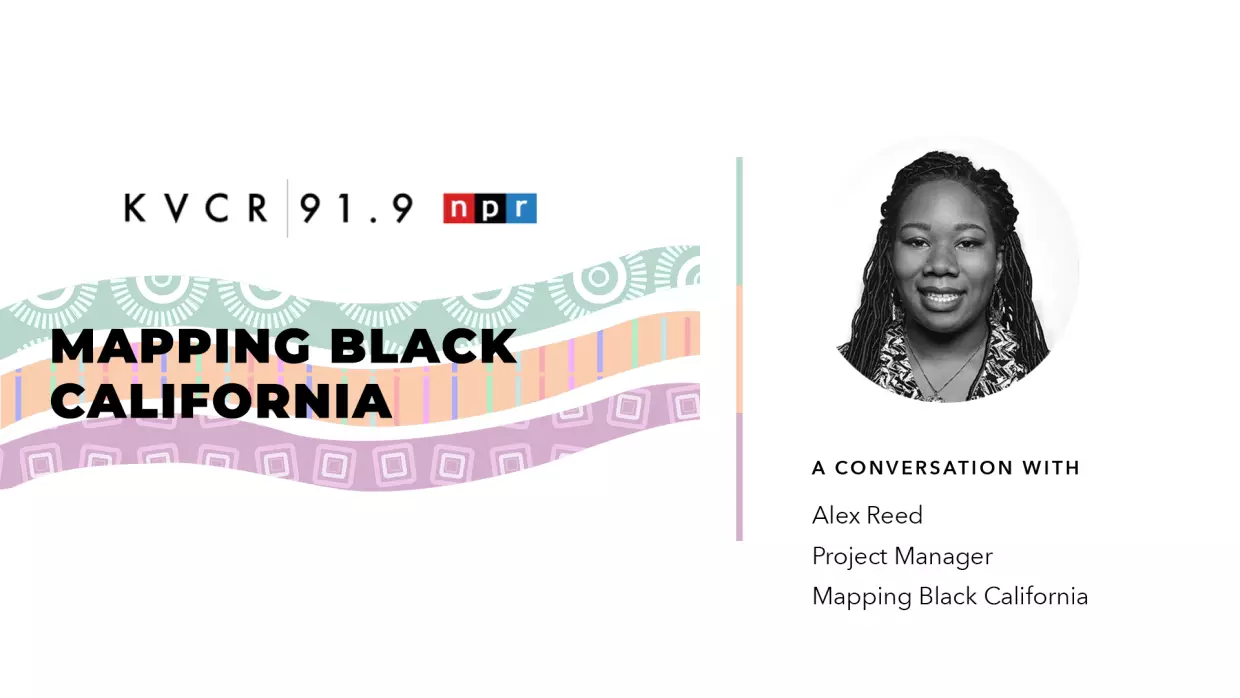
With KVCR Public Media, I'm Maya Gwynn with Black Perspectives IE, a show we learn about the amazing things members of the Black community are doing in the Inland Empire. My guest today is Alex Reed, Project Manager of Mapping Black California, whose mission is to use data and storytelling to highlight the Black experience across California, uncover inequities, and empower communities to drive meaningful change. Thank you so much for being here.
Alex Reed
Of course, thanks for inviting me.
Maya Gwynn
So much of black history, especially in regions like the Inland Empire, gets overlooked or erased when we think about the IE specifically. What are some parts of black history or present-day realities that deserve more attention, in your opinion?
Alex Reed
A lot of our work comes down to mapping sort of like inequities. It's a lot of trying to find ways to tell a story that's not just like doom and gloom all the time. Because the IE - it being an internal immigrant community of people coming out and trying to make a better life for themselves, they'll have a lot of struggle, but in doing that and getting to explore those sort of relationships people have, we've gotten to preserve a lot of the culture that we've established out here, which has been great. You know, we've done projects specifically around Moreno Valley and around Riverside, where we've got these big black populations, and we get to go out and talk to people about their experiences starting small businesses and like clothing out here, or taking their kids around to different parks to figure out like where they want to go, and running into different vestibules, and that sort of thing, and as someone who is not a native to the Inland Empire, for me it's just been a, oh my God, I've never had a chance to really actually go out and explore my community, and sort of preserve and enjoy all those different aspects of black life out here that I didn't even know existed.
Maya Gwynn
And I'm sure a lot of people don't.
Alex Reed
Exactly.
Maya Gwynn
I really like, in your bio, you describe yourself as a data activist. How do you define that role, and what does it mean in your work in Mapping black California?
Alex Reed
Some parts of me are like just taking data down from different places and preserving it, because not even maliciously, government websites change so frequently, it can be so hard to find like the same table at the same page that you were looking for beforehand, and being able to hold on to that is one aspect of the role, being able to like take information that I find out in the world and transform it into ways other people can see and become active around, that's another part of the role. Teaching, you know, data is a part of it. So, there's just so many different bits and pieces. In Mapping Black California, specifically, our whole mission is to take information that people find inaccessible. It's a big table, your computer can't handle it, your mind can't handle it, it's a lot of math, it has to happen, transform that thing, and publish it in a way that is beautiful and actionable, and I think that kind of like sums up all the different aspects of working specifically within a data or computer science world, and still trying to make meaningful change.
Maya Gwynn
Yeah. How does Mapping Black California turn data into action, whether it's policy change, community organizing, or civic engagement?
Alex Reed
It's that same sort of process we try and take everything that we have, or we can transform it into a way that is like really understandable, really supports the lived experiences that we know the community is having, or the community is telling us that they're having, and then we just sort of hand that information back to them, and we're like, you are the ones who can be the best advocate for your situations, and what you need to do is learn how to speak the language of the system of the institutions that you're operating inside, and all we can do is sort of help with that process. We just take the information that supports these narratives, supports these stories, and then we publish it. We make it public, and we try and make it so that you can't dispute it, you can't say your experience isn't real, no one else is going through that. Well, here's all this data that you have published, right? Typically talking about the government, sometimes talking about corporations. You are publishing this, you're maintaining these tables. Don't tell us what we're doing is not real.
Maya Gwynn
An aspect I found really inspiring is Mapping Black California is founded, led, and operated all by black women. How do you feel like that influences the work when so many black women - our culture, is very matriarchal?
Alex Reed
It's twofold, because I definitely feel that I'm like the youngest person in Mapping Black California, and I was when I started the job, no idea what I was doing. And so the two aspects of it are being in a space that is predominantly black, You know, I would say we got two guys that work for us, and we call them out when we meet them. Also black men, amazing. But first of all, we don't have to code switch in that space. We can be presently fully who we are. That does, of course, you know, have the other aspect of it, that is the respectability politics that could come into, like, the black culture, especially among women. I have found that because there is so much work to do, we don't necessarily have that problem, which is great. So there's freedom in it, in that we can be ourselves. And then there's also that challenge of having to make sure that we're navigating that same space respectfully, and then also maintaining our mental health within it, and that can be really hard. Sometimes your coworker needs to take a break, and you need to take on their load, because the work that we're doing is so hard, and it deals with a lot of really tough stuff. So, just being able to like go back and forth and meet that flow is something that I've had to learn to do over the past five years.
Maya Gwynn
And being a safe space for each other.
Alex Reed
Yeah, exactly.
Maya Gwynn
How can everyday community members engage with Mapping Black California, or use its resources to advocate for change?
Alex Reed
it's easy to engage with us. I always say, if you are emailing the inbox, you're talking to me, or talking to Candace. We always try and take time to, when we're engaging with the community, be like clear and transparent, and answer in plain language. If you see something that doesn't look right, call us out, because we want to make sure that we're keeping everything A, up to date, B, accurate, that our understandings of things reflect that of the community experience, and then being actionable around it is really, I feel like engaging with the tools. We want to be that trusted resource that you can ask us first, right? It can't be about should I go to the doctor right now, my toe looks weird, like you just got to go. But if you want to find a place that can, you know, make suggestions as to, well, here are doctors in our networks that we know you can trust culturally, you know, if you are dealing with, like, specifically black issues, LGBTQ issues, like, these are people who are safe. You can ask us. If you say, 'Well, my community is really in need of xyz resource', you can ask us, and we can point you in the right direction. I feel like that's really the way to engage, is to just try to use the tools that we've put out there.
Maya Gwynn
That's incredible and amazing. Is there a piece of history that you found a favorite story, or like a favorite random data point?
Alex Reed
One of the very first projects I did when I started working here was we were mapping all of the black-led organizations across the state of California. It originally just started as just certain territories in Southern California, and then it expanded, and again, as someone who wasn't from the IE originally, moved out here, did like my high school, and all that out here, and kind of came back, the spaces that I was operating in were very white. I went to a predominantly white institution. I grew up in a predominantly white neighborhood that then transformed into a predominantly black and Latino neighborhood, and so I wasn't used to seeing like, us ever. And so doing this mapping project of all these black organizations, over 600 we mapped, I'll say an easy 350 were down here alone.
Maya Gwynn
Wow.
Alex Reed
And I did not know that there were so many people doing the work, and part of that project was those people didn't know there were so many other people doing that work.
Maya Gwynn
It's true.
Alex Reed
So it's been crazy to see as a data point the percentage of engagement, you know, the percentage of network connections expand just from us being able to visualize who was in the space. That's been really, really cool.
Maya Gwynn
It must be so rewarding too. We're gonna move to our rapid fire portion. If your work had a theme song, what would it be?
Alex Reed
What's Barney's theme song?
Maya Gwynn
I Love You, You Love Me?
Alex Reed
Exactly, exactly.
Maya Gwynn
If you have to teach a master class or give a TED talk on a random skill you have, besides the work you already do, what would it be?
Alex Reed
Crocheting.
Maya Gwynn
Oh, I love that. What's your favorite IE restaurant or a landmark that reminds you of the Inland Empire?
Alex Reed
Sharon's Creole Kitchen in Murrieta, CA. That food is so good.
Maya Gwynn
And how can people keep up with you guys and support the amazing work you're doing?
Alex Reed
You can reach out to us directly, info@MappingBlackca.com. Go to our website, Mapping Blackca.com. If you have an organization, get with a database, Black Led or Black Serving. We've got different categories now, that's just Mappingblack.com Anything you type in Mapping Black and California into the Google, you will see us.
Maya Gwynn
Awesome. Thank you so much for coming. This is such a great conversation.
Alex Reed
Yeah, I enjoyed it.
Maya Gwynn
Alex Reed is the Project Manager for Mapping Black California. Find this segment and others at kvcrnews.org/bpie. Support for the segment comes from the Mecca IE Fund at IECF, advancing racial equity and supporting long-term investments in black-led organizations in Riverside and San Bernardino counties. Join us again next week for Black Perspectives IE. For KVCR Public Media, I'm Maya Gwynn. Thank you.