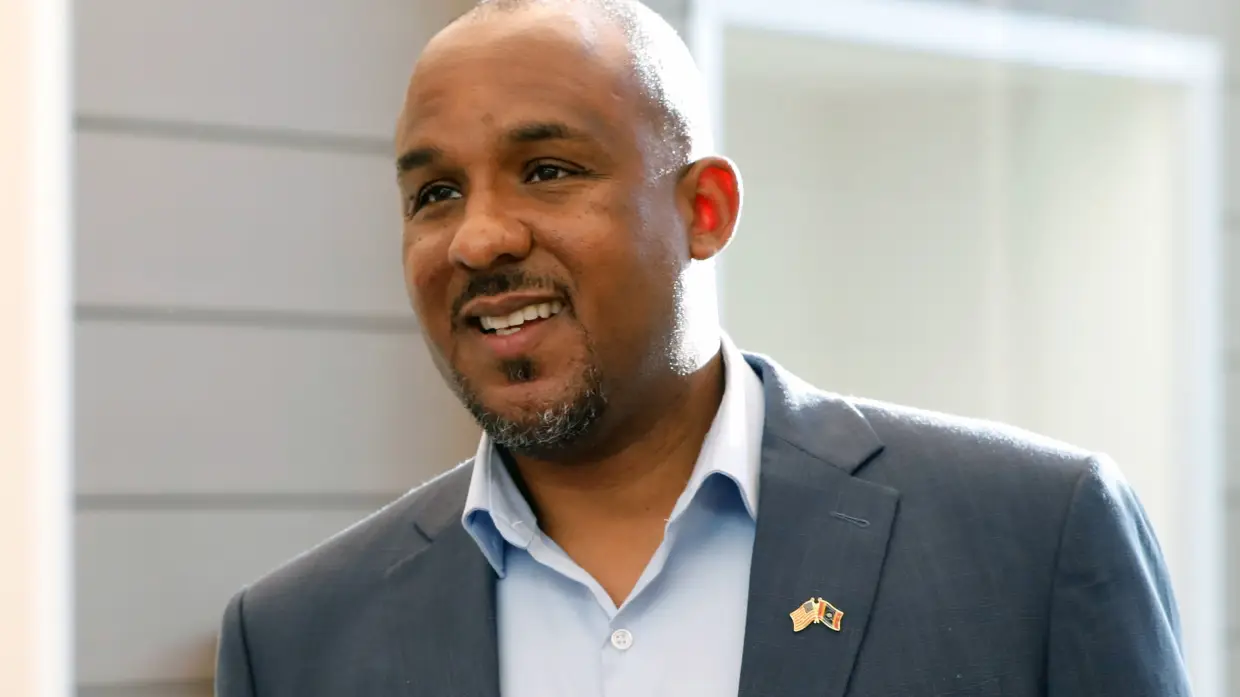
MICHEL MARTIN, HOST: Michigan's winning Senate candidate is on the line with us now. Democrat Abdul El-Sayed defeated Republican Mike Rogers, and his party captured control of the Senate with room to spare.
STEVE INSKEEP, HOST: El-Sayed is a former public health official, activist, also the first Muslim elected to the U.S. Senate. Mr. El-Sayed, welcome to the program.
ABDUL EL-SAYED: Thank you so much for having me. Good morning.
INSKEEP: I guess I should say Dr. El-Sayed. What does this election mean to you?
EL-SAYED: Look, Michigan showed just how big we really are. And we took on a campaign of hundreds of millions of dollars of outside spending, and we built something to get money out of politics, put money in your pocket and pass Medicare for all.
Mike Rogers' campaign wasn't about the issues. It wasn't about gas or groceries or seeing a doctor. It ended up being about me, my name and my faith. And I've always believed that there are a few small people who try to speak loudly for everyone, but Michigan showed just how big we are, that we really want a politics focused on the issues, government of the people, by the people and for the people. I'm just so grateful to the voters in Michigan who gave me their trust, and I hope to serve them and earn that over the next six years.
MARTIN: Dr. El-Sayed, Michel Martin here. We've been talking a lot this morning about whether Democrats got an opportunity, or did they get a mandate? In other words, either Democrats won because people were so disapproving of President Trump or because they see something that Democrats want to do and really are embracing that. Like, I was in your state last week. I was at that rally with, you know, President Obama and you. I heard both things from voters. What do you see?
EL-SAYED: I think this is a mandate to take on Trumpism (ph) and address the crisis of affordability that we're facing in our lives. People understand that Donald Trump has not just not addressed the affordability issues in their lives, he's made them worse.
You think about this illegal, unjustifiable war in Iran. You think about this tariff policy, a tariff war with Canada. We're paying huge at the gas pump. We're paying huge at the grocery store. We're paying $5,600 a year here in Michigan because of his Canadian tariff policy. And then there's the imminent threat of the Medicaid cuts that are just around the corner. So this is about standing up to build a more affordable America by standing up to Trump and Trumpism for a kind of politics that really do put people in the driver's seat.
INSKEEP: Let me ask what to expect if you get your way, and, of course, you're one of a hundred votes in the Senate, and there's also the House. But I watched your debate in which you talked about making Social Security more solvent by having people in the upper end of the income scale pay more than they currently do. You just mentioned Medicare for all, which is something that would involve tax revenue. If you get your way, should some Americans expect to be paying higher taxes?
EL-SAYED: Yeah. If you're a billionaire in this country, you should expect to be paying higher taxes.
INSKEEP: What if you're just kind of upper middle class? You, too?
EL-SAYED: My hope is if you're upper middle class, the amount of money that you're paying out is substantially less than the amount that you're keeping and what you're getting for what you're paying out is so much more.
You know, we live in an economy right now where a few corporations get to dictate the prices that we pay, get to dictate the money that we make. And, you know, the people - I believe in capitalism. We don't live in capitalism right now. What we live in is corporatism. And I think standing up to those corporations is going to be absolutely critical.
And then finally, you think about what we need and deserve in this country. We don't need and deserve more war, more bombs for foreign governments. What we need and deserve is good healthcare and good childcare, functional infrastructure and good schools for our kids.
INSKEEP: I want to ask also about something I saw in a debate with you and Mike Rogers. He kept repeating references to the Muslim brotherhood, references to Israel. And, of course, at the very end of the campaign, you lost the endorsement of Haley Stevens, a Democratic member of Congress you defeated in the primary. And that seemed to be about something having to do with your views, as well as an ad. Why do you think the attacks on you didn't work?
EL-SAYED: Well, because I think people are more focused on what they're getting out of their government right now. They're more focused on the fact that it feels like the harder they work, the less they get. And they're worried about how much they have to pay in gas and groceries. They're worried about whether or not they can see a doctor. And, you know, an opponent pointing to my name and my faith when people are a lot more focused on a number of other issues, it doesn't really land.
The other point I'm making is this - right now we are spending billions of dollars a year to buy bombs and tanks for other countries when that money should be spent here on us. It should be spent on our kids' schools. It should be spent on our infrastructure. And the argument I'm making is an affordability argument. This regime of wars, this regime of a public policy where we subsidize foreign governments isn't working for people. It's costing us, and we can do a lot better.
INSKEEP: Mara Liasson, our political correspondent, has a question for you.
MARA LIASSON, BYLINE: Hi, Dr. El-Sayed. I have a question about what you've said your priorities are going to be when you get to Washington - Israel and healthcare. I'm wondering, since Donald Trump just announced that he is going to stop sending $4 billion in annual military aid to Israel at the end of this year, what is going to be your goal around Israel when you get to Washington?
EL-SAYED: Well, I'll tell you, my priorities are money out of politics, money in your pocket, Medicare for all. I'm asked often about Israel. And when it comes to Israel, I'm just saying that our money should be spent here, not subsidizing foreign militaries. And I think, look, you know, a broken clock is right twice a day. I think the president is actually right on this policy. I'd also like to see us stop selling weaponry that gets used to do the worst things, including genocide and apartheid to Israel. But we have, I think, a responsibility to keep that money here to invest in the things that we need here.
So, look, if he - if that is actually his policy, if that is actually what he intends to do, then, you know, I'm glad to see it because whether it's Israel or Egypt or Saudi Arabia or Jordan or Pakistan, I don't think any of us pay our tax dollars to subsidize foreign militaries.
LIASSON: But you don't have...
EL-SAYED: We want that money spent here.
LIASSON: You don't have any goals around Israel policy beyond that. Is that what...
EL-SAYED: Well, I would like us to actually be dignifying the idea of equal rights to peace, dignity and self-determination for Palestinian and Jewish Israelis alike. I think, right now, what we've often done is we trick ourselves by saying the word two-state solution while we subsidize and aid, arm and abet the very people who are trying to foreclose on the possibility of a Palestinian state.
And so, you know, I'd like to see us move in a direction in the same way we treat any other country that has done the things that Israel has done, that we treat them that way. I don't think we should be running cover for war crimes or genocide at the U.N. or the ICC or the ICJ. I think we should be being objective about the way that we treat Israel, just like we treat any other country.
MARTIN: Mara, I have one more question, which is, Dr. El-Sayed, as I mentioned, I was in Michigan a couple of - just last week as it happens, and it's clear that there are still some core democratic constituencies that are still worried about you or concerned about you. Obviously, certain Jewish Michiganders that made - they made that clear. But also, there are African American voters who said that they were still feeling some kind of way about the uncommitted movement. Do you still think you have some work to do with some of those core democratic constituencies in Michigan, despite your victory? And what are those plans, if you think that's true?
EL-SAYED: Well, I understand that that was a narrative that was being pushed before we actually had electoral outcomes. If you look at the electoral outcomes, we ran at or above, you know, previous indicators for other candidates over the last several elections. So we feel pretty good, but there's always more work to do. There's always more to build. There's always more conversations to have. And I'm looking forward to continuing to earn support that folks gave me over the next six years as we build relationships in and across Michigan.
INSKEEP: Abdul El-Sayed is the Senator-elect from Michigan. And since you talked about more conversations to have, we hope to have you back here on NPR in the coming days. Thanks so much for your time.
EL-SAYED: I'm looking forward to it. Thank you so much.
(SOUNDBITE OF MUSIC)